




Albert Einstein: This One Sentence Changes the Perspective on Life
Heute, 10:45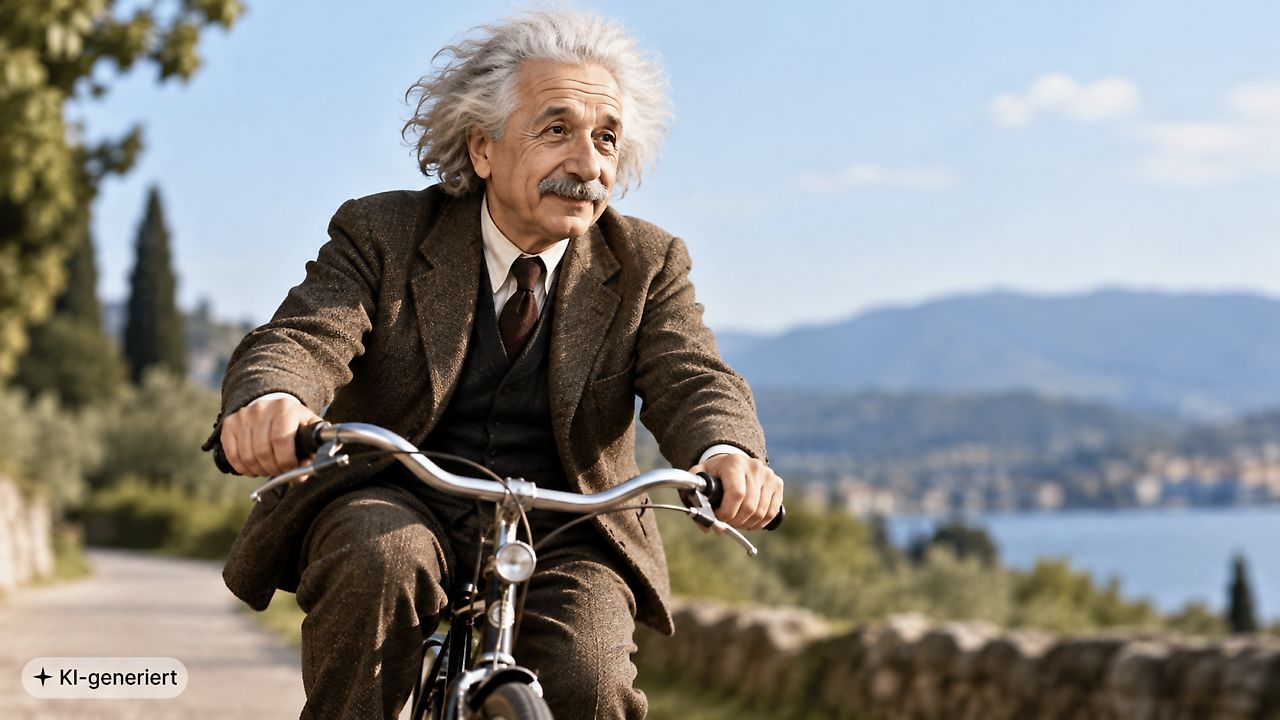
Albert Einstein is one of the most well-known scientists in history. With his work on the theory of relativity, the physicist changed the understanding of space, time, and gravity. But in addition to his scientific insights, he also left personal thoughts about life. One of these comes from a letter to his son Eduard and is frequently quoted to this day.
In February 1930, Einstein compared life to riding a bicycle. The simple formulation developed into one of his most famous aphorisms. Behind it lies a thought that can be applied to changes, difficult decisions, and dealing with uncertainty.
In a letter to his son Eduard in 1930, Einstein wrote in essence that life is like riding a bicycle and one must keep moving to maintain balance.
The widely spread German version today reads:
The formulation is a translation of the frequently cited English quote. The original letter was written in German. Therefore, the exact wording of the widespread German version should not be equated with the historical original text.
The statement connects an everyday experience with a fundamental observation. Anyone who rides a bicycle must continuously adjust their movements to maintain balance. Einstein used this image to express a thought about life.
The bicycle metaphor allows for different interpretations. An obvious interpretation is that stability does not always arise from standing still.
When riding a bicycle, balance is supported by movement and ongoing adjustments. Applied to life, this can mean that people make decisions, gather experiences, and change their direction even in uncertain situations.
It’s not necessarily about being constantly busy or moving forward as quickly as possible.
Rather, the comparison can be understood as a reminder that changes are part of life and adjustments may be necessary.
However, it cannot be definitively derived from this single sentence what comprehensive life philosophy Einstein himself associated with it.
Professional changes, financial worries, or personal conflicts can disrupt the usual life. In such situations, there is often a desire to eliminate all uncertainties first before making a decision.
Einstein’s comparison offers a different perspective. Not every difficulty needs to be resolved before the next step becomes possible.
A step can also be small. Reevaluating a situation, gathering information, or changing an existing plan are different ways to deal with uncertainty.
However, this does not mean that taking action is always the right decision. Waiting, taking time, or seeking support can also be sensible under certain circumstances.
The idea of constantly having to make great progress is not necessarily associated with Einstein’s bicycle comparison.
When cycling, it is often small steering movements that help to keep the direction. Similarly, this idea can be applied to personal challenges.
When faced with a difficult task, one can, for example, break it down into smaller steps. Instead of wanting to implement a comprehensive change immediately, a single decision can initially be the focus.
Reviewing previous expectations or adjusting personal goals can also be understood as a form of development.
These considerations are possible interpretations of the metaphor and not scientifically proven recommendations by Einstein.
An important limitation of the comparison lies in the question of what movement means in a figurative sense.
Not every pause is a standstill, and not every change automatically leads to an improvement.
Especially in stressful phases of life, rest, recovery, and distance can be necessary. Temporarily interrupting a project or postponing a decision does not necessarily mean a step back.
Einstein’s statement should therefore not be understood as an encouragement to always keep going regardless of one’s own capabilities.
The metaphor rather describes a relationship between movement and balance. How this idea can be applied to one’s own life depends on the respective situation.
Albert Einstein was born on March 14, 1879, in Ulm and died on April 18, 1955, in Princeton, USA. His scientific works made him famous worldwide. In addition, he also dealt with social, political, and philosophical questions.
His bicycle comparison is one of those personal statements that were spread independently of his scientific achievements.
The fact that the phrase is still referenced today is also due to its simple imagery. Cycling is a familiar activity where movement, direction, and balance are directly interconnected.
Einstein used this everyday image in a personal letter. From this, a thought developed that became known far beyond its original context.
The central statement can be understood as follows: Balance does not have to mean that nothing changes. Sometimes it is precisely created by people reacting to new circumstances and adjusting their path.
(VIENNA.AT)
This article has been automatically translated, read the original article .

