




Why Our Solar System Could Descend Into Chaos Much Earlier Than Expected
Heute, 04:40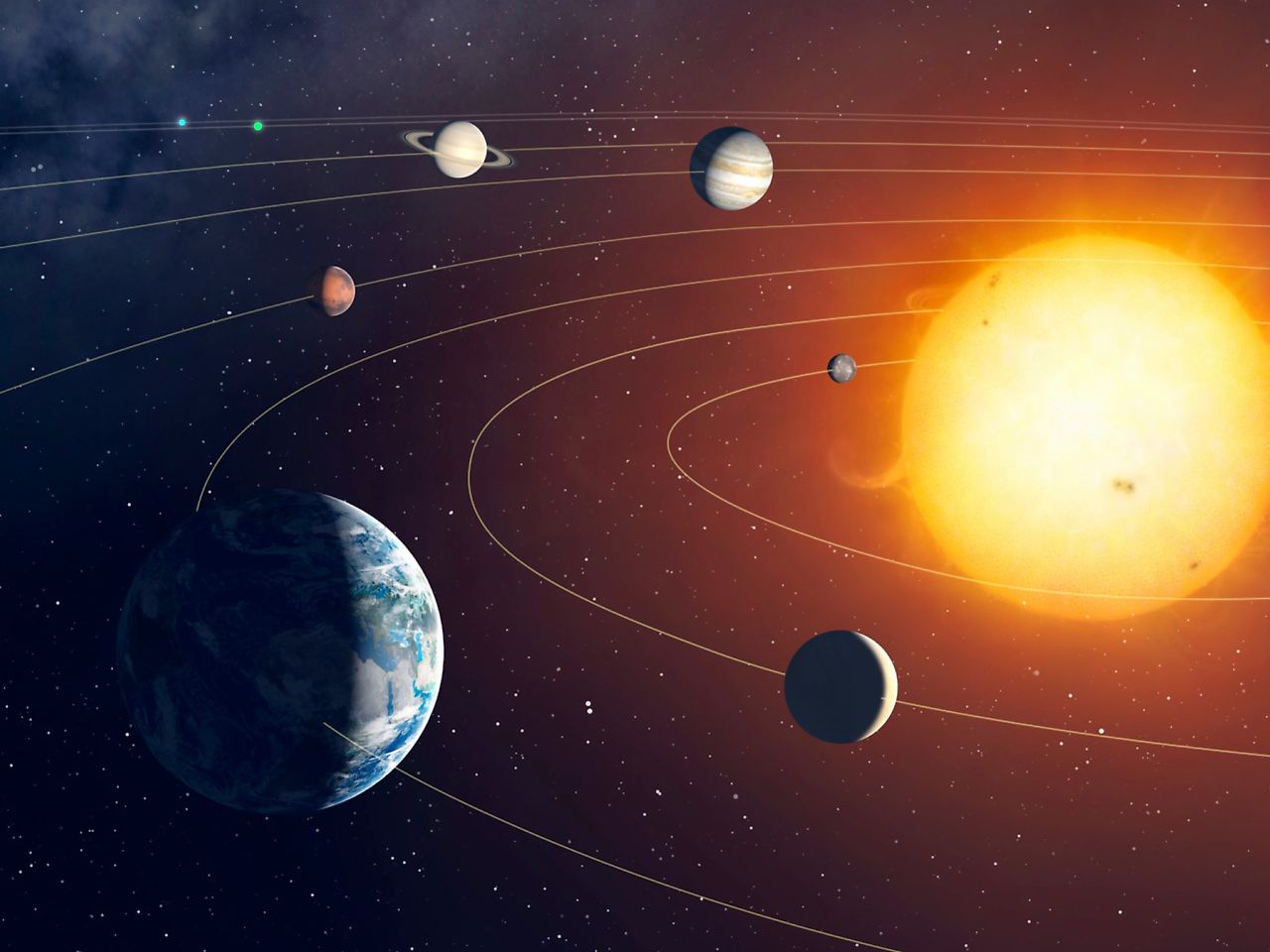
It has long been known that our sun will one day die. In a few billion years, it will swell into a red giant, lose large parts of its outer shell, and eventually remain as a white dwarf. For the inner planets, this development could have devastating consequences. However, at least the outer planets were previously considered relatively safe.
A new study from the California Institute of Technology (Caltech) in Pasadena now questions this assumption. The researchers, led by astrophysicist Konstantin Batygin, have calculated how Jupiter, Saturn, Uranus, and Neptune might behave during the final life phases of our sun. The result: Under certain conditions, the familiar order of our solar system could collapse much earlier than previously thought.
The decisive factor is not just how much mass the sun loses at the end of its life. Much more important could be the way it hurls this mass into space.
Previous models mostly assumed that the sun releases its matter relatively evenly. As a result, its gravitational pull decreases, and the planets move to more distant orbits. According to the new calculations, the sun could lose about 46 percent of its mass. The orbits of the outer planets would thus expand to about 1.85 times their original size.
As long as this process occurs evenly, the simulations suggest that the planetary system remains stable.
However, reality could look significantly more turbulent. Observations of other burnt-out stars provide clues that dying suns do not always eject their matter evenly. Instead, there could be numerous eruptions in which large amounts of gas are hurled in different directions.
Each of these eruptions gives the star a small recoil. What initially seems insignificant could have significant consequences for the orbits of its planets over time.
To investigate this effect, the scientists simulated a scenario with around 4600 individual matter ejections. In each of these, the sun loses about 33 Earth masses and experiences a recoil typically of seven meters per second.
The researchers calculated a total of 672 different scenarios. They considered both the strength of the eruptions and their timing.
The results were particularly striking for the assumed typical ejection amounts: In 37 out of 48 corresponding simulations, where the recoils occurred during all giant phases, the orbits of the outer planets intersected even before the Sun became a white dwarf.
In 19 of these 48 cases, the planetary system was already significantly destabilized at this point.
Some simulations showed particularly drastic developments: Saturn was ejected from the system, while Uranus and Neptune changed their order in other calculations.
However, this does not mean that the planets themselves would be destroyed. Rather, they could leave their previous orbits or even disappear completely from the solar system.
Even after the end of the Sun’s development, the outer solar system did not calm down in many simulations.
Three billion years after the formation of the white dwarf, with the assumed typical ejection strength, 83 to 96 percent of the studied systems had become unstable depending on the timing.
This is a remarkable difference from previous calculations. These assumed that Jupiter, Saturn, Uranus, and Neptune could survive about 30 to 100 billion years after the death of the Sun before encounters with other stars would significantly change their orbits.
The new results suggest that instability could occur around 100 times earlier under certain conditions.
(Ed.)
This article has been automatically translated, read the original article .

