




Chemistry Nobel Prize: Their Discovery Changes Medications
Heute, 12:25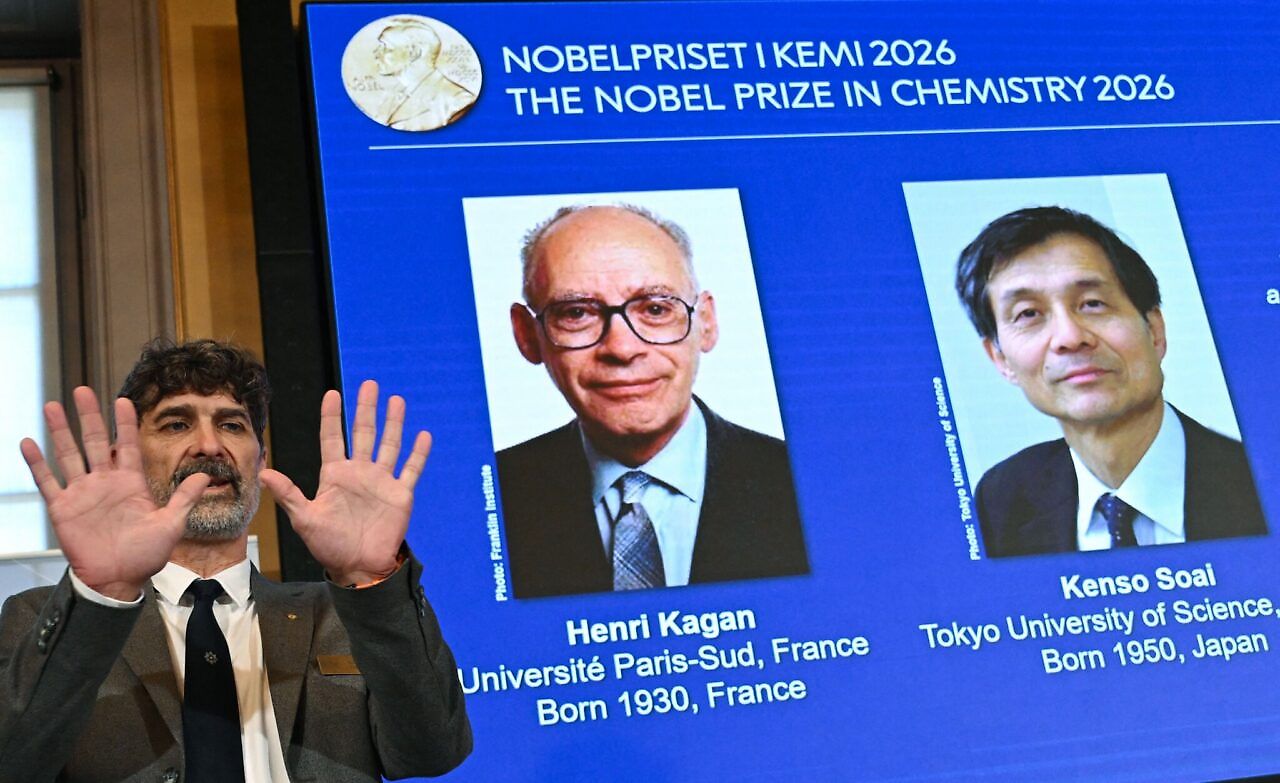
This was announced by the Royal Swedish Academy of Sciences in Stockholm.
„Henri Kagan and Kenso Soai have provided a solution to a chemical puzzle that is over a century old: how homochirality can spontaneously arise,“ explained the chairman of the Nobel Committee for Chemistry, Heiner Linke.
What does chirality mean? Many molecules, such as amino acids, exist in two variants that behave like mirror images of each other – comparable to the left and right human hand. The two variants, the so-called L- and R-form, have completely different properties. In nature, one of the two variants usually dominates.
At docking sites, for example, of human cells, one variant of a molecule fits perfectly – like a key in a lock. The other – the mirrored key – does not fit and can even damage the lock.
The principle is of central importance in medicine: Many modern drugs are specifically developed as a single so-called enantiomer that has a desired effect. The other variant, which can be ineffective or toxic, is avoided.
The phenomenon was significant, among other things, in the thalidomide scandal of the 1960s: While one form of the thalidomide active ingredient inhibits inflammation, its mirror image leads to malformations in unborn children.
Kagan, who conducted research at the Université Paris-Sud, discovered a way to influence chemical reactions in 1986. This allowed him to produce a greater excess of one of the two mirror images.
Soai from the Tokyo University of Science introduced a chemical reaction in a 1995 publication that had the theoretical potential to produce homochiral molecules. In 2003, he then presented a reaction in which only one of the two mirror images was actually formed. Apart from life itself, no one had previously accomplished this feat, writes the Nobel Committee. „The chemical reactions they developed are spectacular,“ said Linke.
„I am very pleased to have received this wonderful news about the Nobel Prize. This is one of the most exciting days of my life,“ said Soai, when he was connected from Japan to the prize announcement in Stockholm. He was very pleased to be able to share the prize with Kagan.
The most prestigious award for chemists is endowed this year with a total of twelve million Swedish kronor, equivalent to around one million euros.
The Nobel Prize announcement began on Monday with medicine: For their discoveries in optogenetics, Peter Hegemann (71) from Humboldt University Berlin, Georg Nagel (73) from the University of Würzburg, and the US researcher Karl Deisseroth (54) are being honored.
The Physics Nobel Prize was awarded on Tuesday to the Belgian-American researcher Francis Halzen (82) from the University of Wisconsin in Madison for significant contributions to the neutrino observatory „IceCube“.
The ceremonial presentation of the awards traditionally takes place on December 10, the anniversary of the death of the prize founder Alfred Nobel.
(dpa)
This article has been automatically translated, read the original article .

