




2,000 Years Hidden: Researchers Discover Roman City in Lower Austria
24-09-2026, 18:25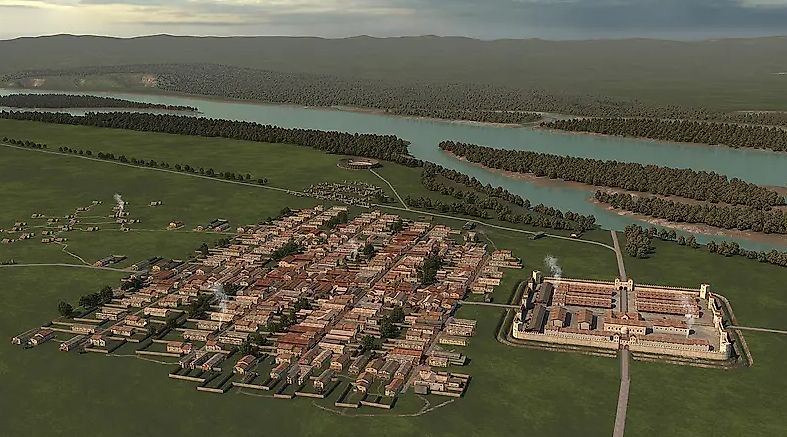
For almost 2,000 years it remained hidden – now, at St. Pantaleon-Erla in the district of Amstetten, the picture of a previously unknown Roman city is emerging. Geophysical surveys reveal a systematically planned settlement with a regular street network and a large amphitheater.
Involved in the discovery are, among others, the Forum Donaulimes, the University of Innsbruck, GeoSphere Austria, Research Archaeology, as well as the state archaeologies of Lower Austria and Upper Austria.
The dimensions are surprising: The city area is said to have extended over 25 to 30 hectares.
Particularly impressive is the amphitheater that became visible during the measurements. It is said to have accommodated around 8,000 people and was thus about as large as the one in Carnuntum.
The special thing about it: The city emerged in the vicinity of a garrison of only about 500 soldiers.
According to the report, such a large and systematically planned settlement at an auxiliary troop fort of this size is so far without comparison in the Roman Empire.
The researchers have also identified traces of several military installations in St. Pantaleon-Erla.
These include two Roman stone forts, a wood-earth camp from the 1st century AD, and a stone fort from the 2nd century.
The location is likely to have been of great strategic importance. According to the report, the installations primarily served to control a Danube crossing in the area where the Aist flows in from the north.
The Aist Valley formed a short transport route between the Danube and the Vltava, making it relevant for trade outside the Roman Empire as well.
Particularly intriguing is the question of the city’s name.
The geographer Claudius Ptolemy mentioned a place called Claudivium in the 2nd century AD. According to researchers, the coordinates he provided could match the Roman city now being studied in Stein near St. Pantaleon-Erla.
A river mentioned by Ptolemy with the same coordinates, flowing in from the north, could also have been the Aist.
However, the identification is not confirmed. Therefore, the possible name is still listed with a question mark in the research documents: Claudivium?
Archaeological finds, especially coins, indicate an abrupt end around the year 180 AD.
In this year, Emperor Marcus Aurelius died. His son Commodus ended the Marcomannic Wars, which had been ongoing since 166, through a peace agreement.
Around the same time, the nearby Lauriacum, today’s Enns, was expanded as a site for a Roman legion.
The researchers connect these developments: While Enns remained or was expanded as a military site, the fort and settlement near St. Pantaleon-Erla were apparently abandoned in a planned manner.
For archaeology, it is particularly important what did not happen afterwards: According to the report, the place was never settled again.
As a result, the Roman settlement structure remained comparatively undisturbed. Researchers therefore speak of an archaeological time capsule.
The site could thus also play an important role in the international research of the Roman Danube Limes.
Despite the exceptional preservation, there is a danger to the site.
Archaeological zones in agriculturally used areas are not immediately threatened, but agriculture causes a gradual destruction.
According to researchers‘ assessments, parts of the forgotten city as well as other archaeological areas in the region could be damaged or destroyed within a few decades – regardless of possible monument protection.
Further investigations are now intended to help complete the picture of the Roman settlement landscape between St. Pantaleon-Erla and Enns.
(Red)
This article has been automatically translated, read the original article .

