



The student social survey is a study conducted since the 1970s, for which questionnaires are sent to all regular students. It is now conducted online, and the questions were fully completed in the summer semester of 2025 by around 36,000 students (equivalent to a little more than one-tenth), according to project leader Anna Dibiasi from the Institute for Advanced Studies (IHS) at a press conference.

New Student Social Survey Shows Sharply Rising Costs in Dormitories
14-04-2026, 16:28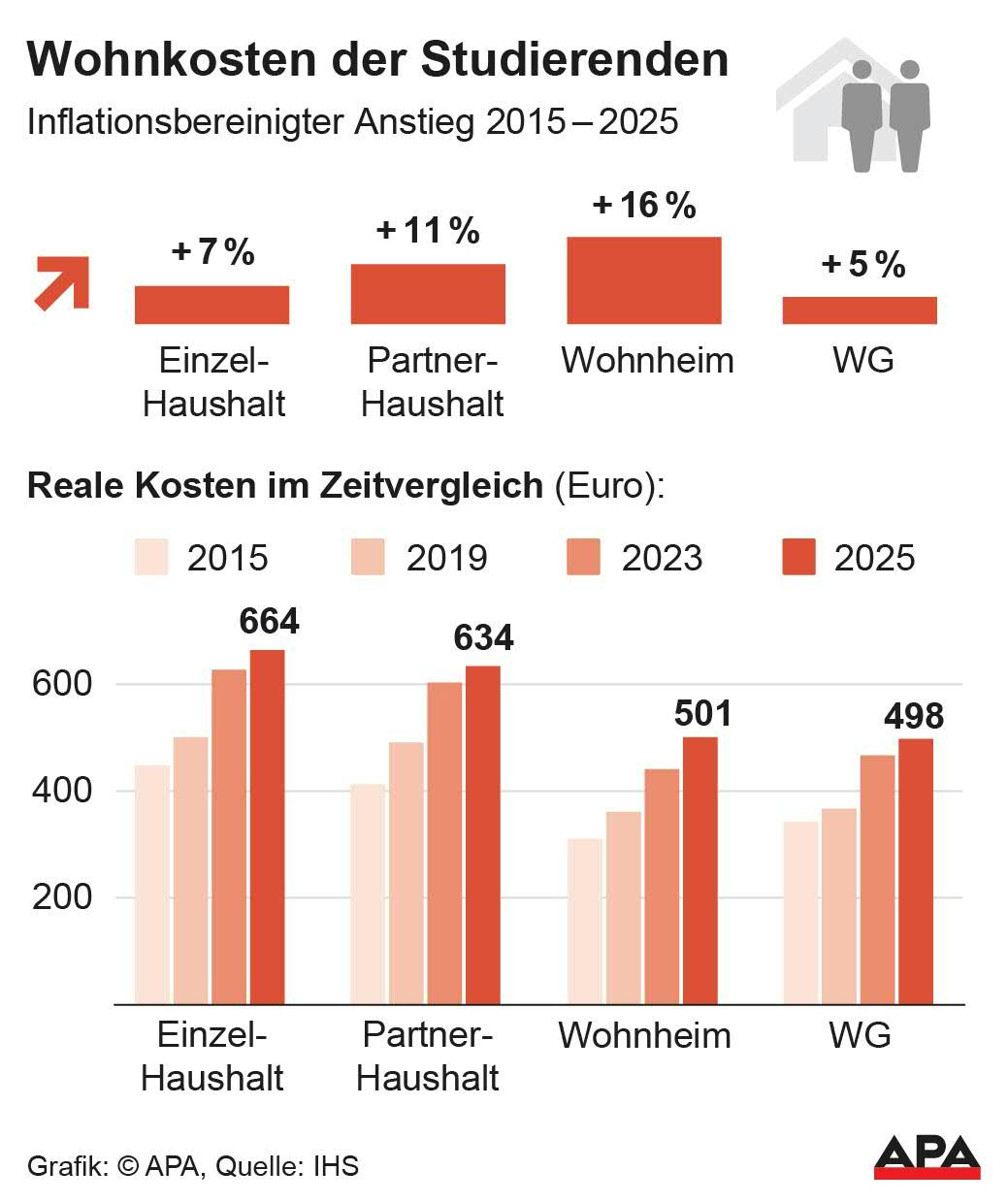
The costs of housing for students, as with other population groups, have increased in recent years. This is confirmed by the new student social survey released on Tuesday. The costs have risen particularly sharply in dormitories. However, the number of students complaining about financial difficulties has decreased. The proportion of working students has also slightly declined.
Students: On average around 590 euros per month for housing
The average housing costs of students who do not live with their parents or other relatives (and do not engage in distance learning and contribute to housing costs) amounted to around 586 euros per month in the summer semester of 2025. This corresponds to an increase of seven percent since 2023 and 51 percent in a ten-year comparison since 2015. Adjusted for inflation, housing costs have hardly increased since 2023 (plus 0.3 percent) and have risen by nine percent since 2015.

However, there are significant differences: A quarter of the students have monthly housing costs of less than 400 euros. Half have housing costs up to 505 euros monthly, and the "top" quarter pays more than 700 euros a month. On average, students spend 38 percent of their total budget on housing (2015: 36 percent).
The decisive factor for the amount is primarily the type of housing: As expected, students in single households (664 euros) and in households with partners (634 euros) spend the most on housing on average. Students in shared apartments and in dormitories run by non-profit and private operators each pay around 500 euros on average. Unlike all other housing types considered, costs in dormitories have also increased in the last two years when adjusted for inflation (plus seven percent). Since 2015, there has been a nominal increase in costs in dormitories by 61 percent and a real increase by 16 percent. This is mainly due to the increasing number of private, commercial operators.
For Holzleitner an "alarm signal"
For Science Minister Eva-Maria Holzleitner (SPÖ), this is an "alarm signal". In the government program, the reintroduction of student housing subsidies has been planned. This will also be a subject of the upcoming budget negotiations - she did not want to commit to a specific amount. However, ÖH Chairwoman Selina Wienerroither (Association of Socialist Students/VSStÖ) did mention a number: A few years ago, 50 million euros were demanded for this - this demand remains in place.
Apart from housing, some positive trends can also be noted in the survey: The proportion of students with financial difficulties has decreased from 29 to 25 percent since the last survey - however, the pre-crisis level has not yet been reached. The proportion of working students has slightly decreased - to 68 percent. The extent of employment has decreased relatively more. With an average of 20.2 hours, it is almost back to the level of 2015 (19.9 hours) after 21 hours in 2023 and 20.5 hours in 2019.
To relieve students, there will also be a ministry-funded 5-euro menu for students in the cafeterias starting from the upcoming winter semester. For this, operators must adhere to certain quality standards, according to Holzleitner. It will start at some selected locations, and later the program is to be expanded.
Housing Costs Increased: Reactions from Politics and Business
The Greens called on Holzleitner to also implement her promises. "The data is on the table. What must follow now are concrete actions instead of mere political declarations of intent," said Science Spokeswoman Sigrid Maurer in a statement. The Chamber of Labor (AK) demanded, among other things, a "strong increase in study grants, at least above the poverty risk threshold," while the ÖVP-affiliated Action Community demanded the valorization of additional income limits for grant eligibility (currently 17,212 euros/year).
(APA/Red.)
This article has been automatically translated, read the original article .

